
Fort Lauderdale Address History Sources
No single roll names every person who occupied a Fort Lauderdale property. The most reliable route is chronological. Begin with the present parcel, follow recorded ownership backward, then add sources that name subscribers, family members, applicants, or heirs. Each source answers a different question. A deed proves a transfer of land; a telephone book shows a listed subscriber; a census may identify the household present on enumeration day.
| Local source | Verified time span | Place to search | Evidence found |
|---|---|---|---|
| Fully searchable recorder index | July 7, 1977 at 1:47 p.m. to present | Broward Official Records | Parties, type, date, instrument, and image |
| Limited recorder index | March 9, 1972 to July 7, 1977 | Broward Official Records | Instrument, book/page, and date keys |
| Older recorded media | 1871 to 1977; ownership guidance says since 1883 | Search and Copy, Room 114 | Images of older instruments |
| Fort Lauderdale phone books | 1941 to 1947 verified online | Library of Congress | Listed subscriber, address, and phone |
| Federal census schedules | Public through 1950 in 2026 | NARA and library databases | Household members and relationships |
| Permits and code records | Current digital coverage; archival start not stated | City portal or records request | Work, applicants, dates, and inspections |
The era controls the starting point. Recent work begins with the Broward County Property Appraiser and the recorder. A mid-century search gains more from telephone books and census schedules. For an older building, plats, legal descriptions, Sanborn maps, and predecessor-county records may matter more than the modern house number.
Start Fort Lauderdale Previous-Resident Research
Search the Broward County Property Appraiser by street address. Save the owner spelling, folio, situs address, mailing address, legal description, and last sale or instrument reference. The folio is the county parcel identifier. The situs address is the physical tax location, while the mailing address is where tax notices go. Those fields can differ without proving why.
County guidance specifically sends deed researchers to BCPA first because the official-record deed workflow is keyed to an owner. That detail prevents a common dead end. The appraiser roll also may show an exemption, values, building traits, and sales. Homestead status can suggest that an owner used the parcel as a permanent home for a qualifying tax year, but it does not identify a spouse, child, renter, roommate, or every prior occupant.
Walk Broward Deeds Backward
A chain of title is the linked sequence of recorded land transfers. To trace Fort Lauderdale previous residents, treat each deed as a bridge to the one before it. Match the same parcel or legal description at every turn. Names alone are weak evidence, especially where common names, trusts, business owners, and spelling changes appear.
- Copy the current owner, folio, legal description, and deed reference from BCPA.
- Open that purchase deed in Broward Official Records. Record both parties, dates, instrument number, and legal description.
- Search the seller as a grantee in an earlier period. That earlier purchase should identify the next seller.
- Repeat the link, checking spelling variants and the land description each time.
- At the online cutoff, switch to book/page or instrument keys, then ask Search and Copy for older media.
- Grantor
- The person or entity transferring an interest in the land.
- Grantee
- The person or entity receiving the recorded interest.
- Chain of title
- The connected series of instruments that carries ownership through time.
- Legal description
- The lot, block, subdivision, or survey language identifying the land even when its street address changes.
Fort Lauderdale's Minute-Exact Index Cliff
Broward publishes unusually exact search cutoffs. Full document searching begins July 7, 1977 at 1:47 p.m. The period from March 9, 1972 at 11:28 a.m. through that cutoff supports only limited instrument number, book/page, and recorded-date methods. Earlier records do not appear in the same web search. This is a records-access boundary, not proof that a deed never existed.
The county describes older Search and Copy media reaching from 1871 through 1977, while separate deed guidance says ownership records are available since 1883. Keep both statements distinct. Ask staff which series covers the needed parcel. Broward County Records, Taxes and Treasury operates the Recording and Search and Copy functions at the Governmental Center, 115 S. Andrews Avenue, Room 114. Staff can locate and copy records but cannot decide title or provide legal advice.
The Broward Records Division page explains those services and older-media access.
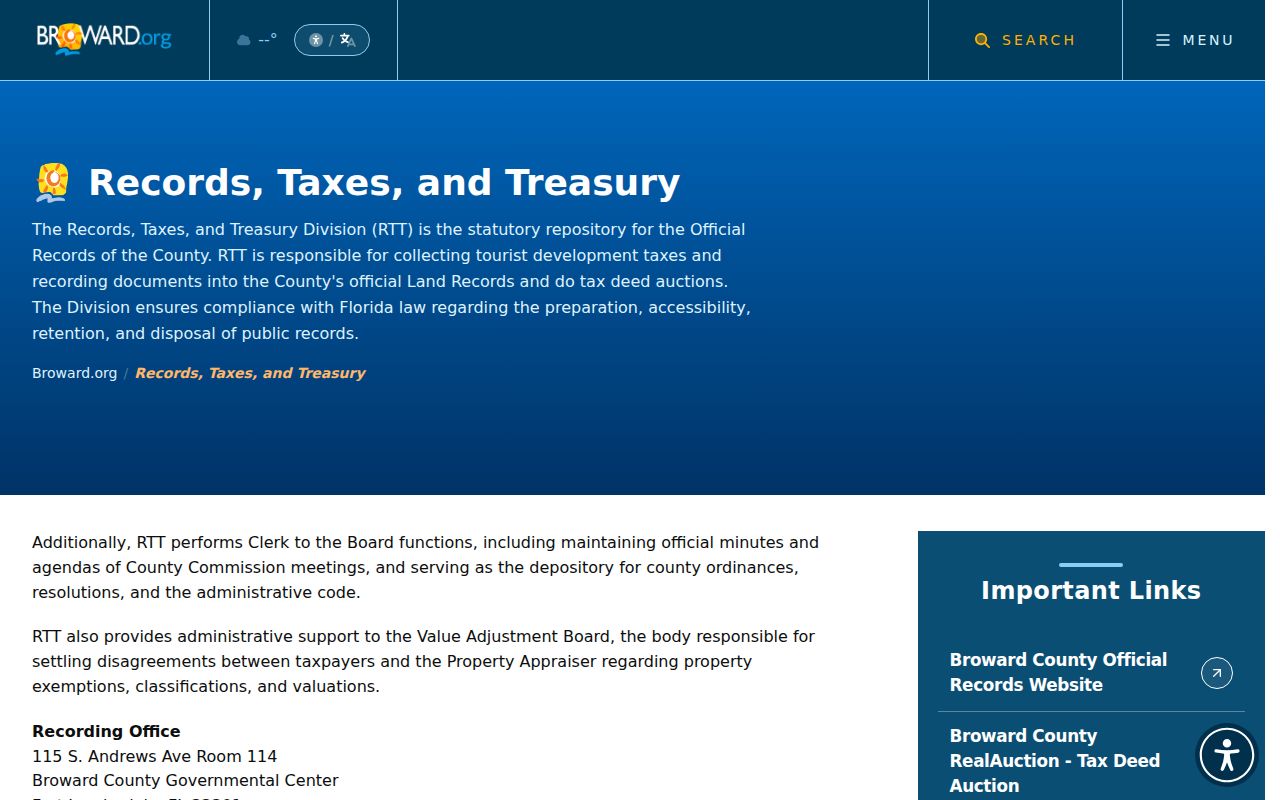
The captured page is a reminder to move from the web index to the records office when the date or search key falls outside modern coverage.
Previous Residents Before Broward County
Broward County was formed in 1915 from parts of Dade and Palm Beach counties, with Fort Lauderdale as the county seat. That event creates a hard break in the archive. Post-1915 county deeds, tax material, and court files belong in Broward series. Earlier Fort Lauderdale-area transactions may sit in predecessor-county record groups.
Do not read a missing Broward result as a missing land history. Carry the legal description, subdivision name, survey detail, and the names of parties into older Dade or Palm Beach research. Florida Memory's Broward officials index begins with the county's 1915 officers and helps document the new local administration. Plats, tax rolls, newspapers, and probate can span a gap when the deed index does not.
Match Fort Lauderdale Past Households
Owners are only part of the past-resident story. The Library of Congress has 884 digitized images in its Fort Lauderdale telephone-directory item covering January 1941 through February 1947. A white-page entry can give a subscriber's name, street address, and telephone exchange or number. It can omit non-subscribers and other people at the same address, so it is evidence of a listing, not a complete household roll.
Pair sources in a set order:
- Browse a directory by surname or by street and house number when a reverse section exists.
- Compare adjacent editions to spot an address, spelling, or subscriber change.
- Match 1940-era directory evidence to the 1940 census, then compare late-1940s listings with the 1950 census.
- Use deed and tax records to determine whether a listed adult also owned the parcel.
Census schedules can add age, birthplace, relationship, and occupation for the people present in a household. The fuller collection details belong on the Fort Lauderdale city directory page. For backward address work, the key is to place each listing on the same parcel and date line.
Date Fort Lauderdale Homes and Addresses
Names can stay stable while the building changes. Fort Lauderdale permits may show additions, demolition, conversion, work scope, applicant, contractor, and inspection dates. They date work, not a transfer or a person's full period of residence. Code records can add events tied to the address, but the named responsible party is not automatically an occupant.
Sanborn fire-insurance maps add building footprint, construction material, use, and historic street numbering where a local edition covers the block. Broward County Library and NSU provide a licensed Digital Sanborn Maps route, while Library of Congress and University of Florida catalogs offer other editions. Exact local years were not verified in the research, so check the catalog rather than assume coverage.
Use the folio and legal description when directional prefixes, renamed roads, subdivision replats, or annexations disrupt a literal search. NE 1st Street and NW 1st Street are different places. A postal city of Fort Lauderdale also does not guarantee that city permit staff hold the record.
Close a Fort Lauderdale Owner Trail
A deed chain may end with an estate rather than a normal sale. Search the Broward Clerk probate docket for an administration or determination of heirs, then look for a recorded deed signed by an estate or personal representative. Probate identifies a legal case and possible heirs; it does not prove that each heir lived at the property.
Obituaries, cemetery material, and library newspaper databases can add family links and dates. Broward County Library offers Historical Black Newspapers, Southeast Regional Newspapers, and local microfilm access. Corroborate an obituary with a death record, probate case, or recorded estate instrument before attaching it to previous residents of the address.
When a needed file is not online, the Broward Clerk records-request page provides the court and archive request route.
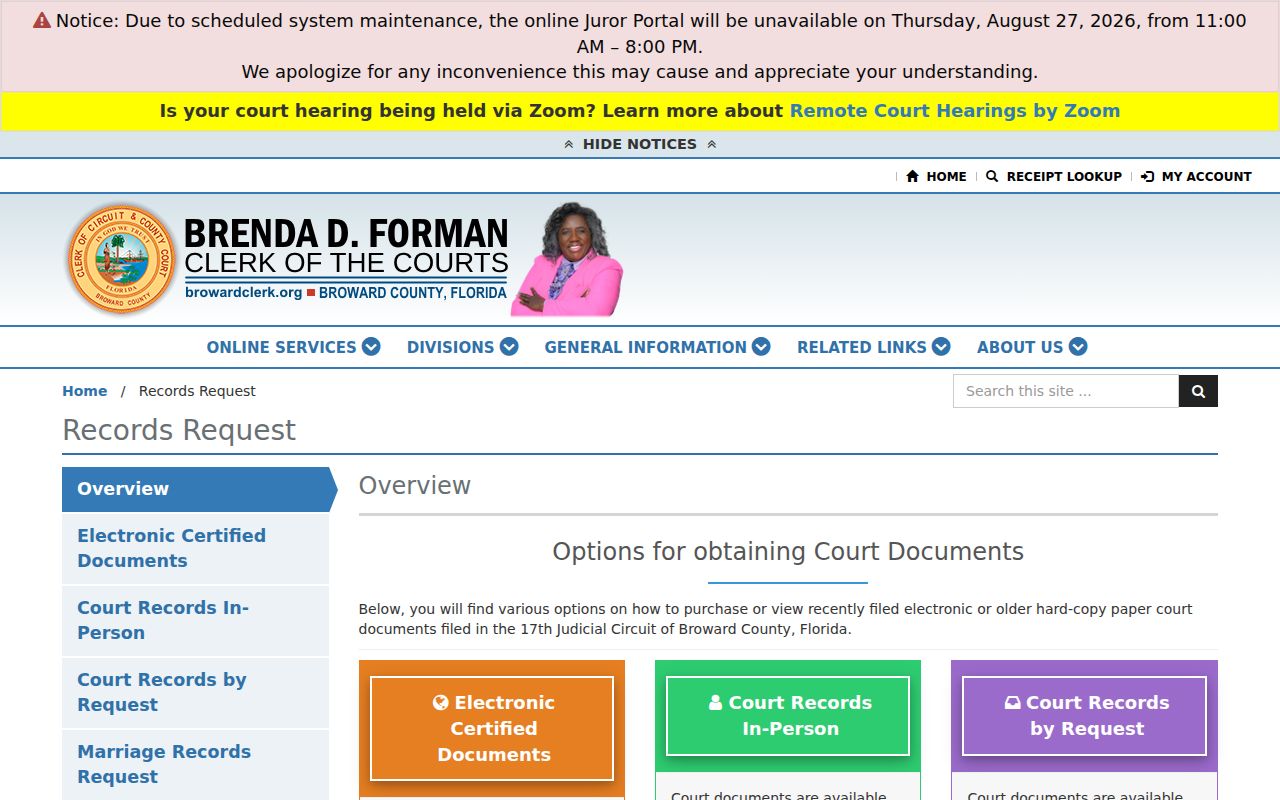
The request screen supports the fallback from an index hit to the file needed to verify an estate link.
State-level appeals are searched separately through the Florida Courts Online Public Docket. An appellate entry may help follow litigation involving a former owner, but a party name or case record does not show that the person occupied the Fort Lauderdale address.
The state docket page is a court-history cross-check, not a substitute for a deed, directory listing, census schedule, or other address-linked source.
Federal matters use PACER, including cases from the Southern District of Florida. Search it only when another verified source points to a federal case connected with the deed, estate, or property dispute.
PACER supplies docket and document access, yet a federal filing can confirm litigation only. It cannot establish who lived at a Fort Lauderdale house.
The Florida Department of Law Enforcement criminal-history service is likewise a name-based state record, not an address-history source. It should never be used to fill a gap in the chain of previous residents.
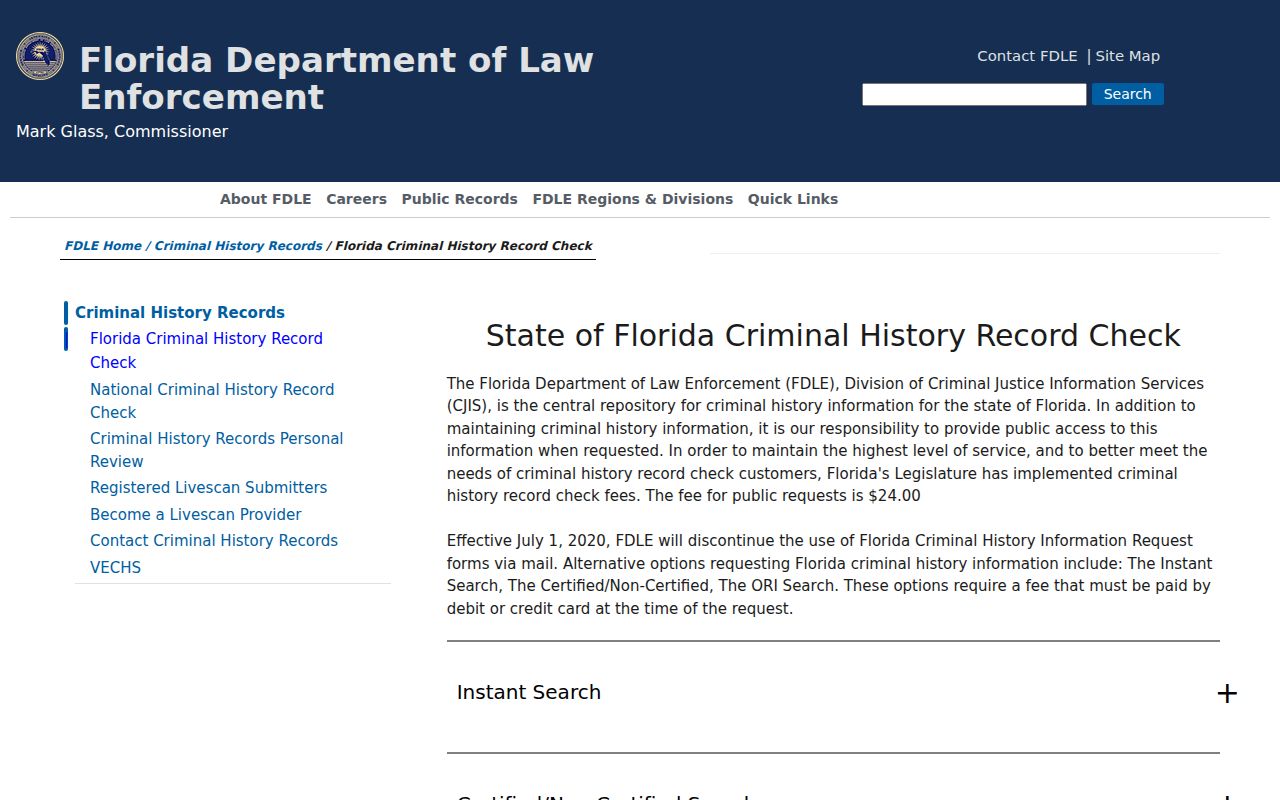
The captured FDLE page helps define that boundary: criminal-history results do not prove ownership, tenancy, household membership, or residence at the property being researched.
Use Previous-Resident Records Lawfully
Previous-resident research works best for family history, heir research, preservation, and curiosity about a home. Public access does not make every fact complete or safe to republish. Vital records have eligibility limits, sealed court material stays closed, and protected addresses may be withheld under Florida law.
Label each fact precisely. An owner is not always an occupant. A tax mailing address is not always the home. A telephone subscriber is not every person in the household, and a missing directory entry does not prove a move. Date every note and keep the official link or image that supports it.
Lawful use. Use Fort Lauderdale previous-resident records for legitimate house and family history, never to watch, threaten, harass, or harm a living person.