
Finding Fort Lauderdale Residents
Start with the kind of fact already known. A street address belongs first in the Broward County Property Appraiser search. It returns a parcel, owner name, legal description, tax mailing address, values, use, exemptions, improvements, and sales history. A person’s name can be checked in the Broward Clerk case search, the Official Records name index, Sunbiz business filings, or the state professional-license search. For an older name, Broward Main Library and the Library of Congress telephone books supply dated directory evidence. This Fort Lauderdale residents directory works best as a route among those custodians, not as a claim that one list is complete.
Each roll has a narrow purpose. A tax owner may live elsewhere. A voter record can support a current registration link but does not prove that the person is at home today. A deed identifies parties to a transfer, while a court docket only shows that a name was connected to a case. Renters, children, unlisted adults, and people protected by confidentiality laws may be absent. Two records that agree on a middle name, parcel, date, or mailing address are far stronger than a loose name match.
- Enter the address or owner name in BCPA and save the folio, legal description, and exact spelling.
- Check an individual registration through the Broward Supervisor of Elections lookup, or request an allowed voter extract.
- Use the owner name and folio in Broward Official Records to find deeds, mortgages, liens, and recorded judgments.
- For past residents, compare city directories, telephone books, census schedules, newspapers, and deed dates.
- When a city or county record is not posted, send a narrow public-record request to the office that created it.
Fort Lauderdale Resident Record Keepers
Fort Lauderdale is the Broward County seat, so several key resident rolls sit close together but remain under different custodians. Records, Taxes and Treasury records deeds and other official instruments. The Property Appraiser maintains the assessment roll and parcel search. The Supervisor of Elections handles registration records. The Clerk of Courts keeps county and circuit court files. The city clerk, police department, and city departments answer for municipal records such as permits, code files, minutes, and public correspondence. Florida Public Records Law permits any person to ask, generally without stating a purpose, but exemptions and reasonable service charges still apply.
Broward Recording Section
115 S. Andrews Avenue, Room 114
Fort Lauderdale, FL 33301
954-357-6716
Broward Property Appraiser
115 S. Andrews Avenue, Room 111
Fort Lauderdale, FL 33301
954-357-6830
Broward Elections Office
4650 NW 21st Avenue
Fort Lauderdale, FL 33309
954-357-7050
Search Fort Lauderdale Property Names
The BCPA portal is the strongest official starting point for a current address. Its search hub accepts property, owner, sales, subdivision, time-share, commercial, and land queries. A result can show the owner of record, situs address, tax mailing address, folio, legal description, use code, assessed values, exemptions, improvements, sales, and deed references. Situs means the parcel’s physical location. The mailing address is where the tax notice goes, which may belong to an owner, trust, company, or agent somewhere else.
The official Broward property search pictured below shows the distinct entry points available to a resident search. Copy the folio and the latest deed reference before leaving the result.

Those identifiers prevent a common error: joining two people with the same name to the wrong property. Homestead status can support that an owner claimed the parcel as a permanent home for a tax year, but it does not name renters or prove day-to-day presence.
Broward Deeds Behind Resident Names
Broward Official Records turns a parcel owner into a dated chain. The index supports party name, date range, document type, instrument number, book and page, case number, consideration, and parcel-related modes. Results may show grantor and grantee names, recording date, instrument number, document type, legal description references, and an image. A grantor transfers an interest; a grantee receives it. Neither label proves where either party slept.
The coverage boundary matters. Records from July 7, 1977 at 1:47 p.m. forward are fully searchable online. The earlier span from March 9, 1972 through that cutoff has limited instrument, book and date access. Search and Copy in Room 114 holds older media reaching 1871, although Broward County was not created until 1915. A pre-1915 Fort Lauderdale land trail may continue in Dade County predecessor records. That local chronology makes the deed index one of the most useful parts of a Fort Lauderdale residents directory.
- Index
- A finding aid that points to a filed record; it is not always the full document.
- Folio
- Broward’s parcel identifier, used to keep the land match stable through name changes.
- Legal description
- The lot, block, subdivision, or land wording that identifies the property.
- Plat
- A recorded map showing lots, blocks, dimensions, and public dedications.
Current Fort Lauderdale Resident Rolls
Present-day names are divided among records created for tax, election, court, licensing, corporate, and city business. None is a household census. Choose the roll whose purpose fits the question, then compare it with a second source. The Fort Lauderdale residents directory is most reliable when the same name is tied to a stable parcel, middle name, business role, or dated filing rather than a broad city match.
| Fort Lauderdale source | Names represented | Official keeper | Public route |
|---|---|---|---|
| Assessment roll | Owners and tax-mail recipients | Broward Property Appraiser | Free portal |
| Voter registration | Registered voters, with protected fields removed | Broward Supervisor of Elections | Lookup or data request |
| Official Records | Parties to deeds, liens, judgments, and mortgages | Broward Records, Taxes and Treasury | Free covered-year index |
| City staff directory | Public employees in official roles | City of Fort Lauderdale | Free department pages |
| Sunbiz and DBPR | Business officers, agents, and license holders | Florida state agencies | Free search and images |
Sunbiz offers unusually broad search modes, including officer or registered agent, document number, FEI, ZIP, and street address. DBPR accepts a name, license number, city or county, and license type, with an option to include historic licenses. These records confirm a business or professional link, not a home. The Fort Lauderdale resident lookup gives the full name-first workflow.
Fort Lauderdale Court Party Search
The Broward Clerk is the official custodian for county and circuit cases in Florida’s Seventeenth Judicial Circuit. Its party search requires a court type, last name, and first name. Optional controls include case type, middle name, and a paired filing-date range. Short names return exact matches, and results stop at 200, so a middle name or date range can be vital. The list shows a case number, division, case type, filing date, status, and matched party.
The official Broward case search image shows the fields used to narrow a common name.
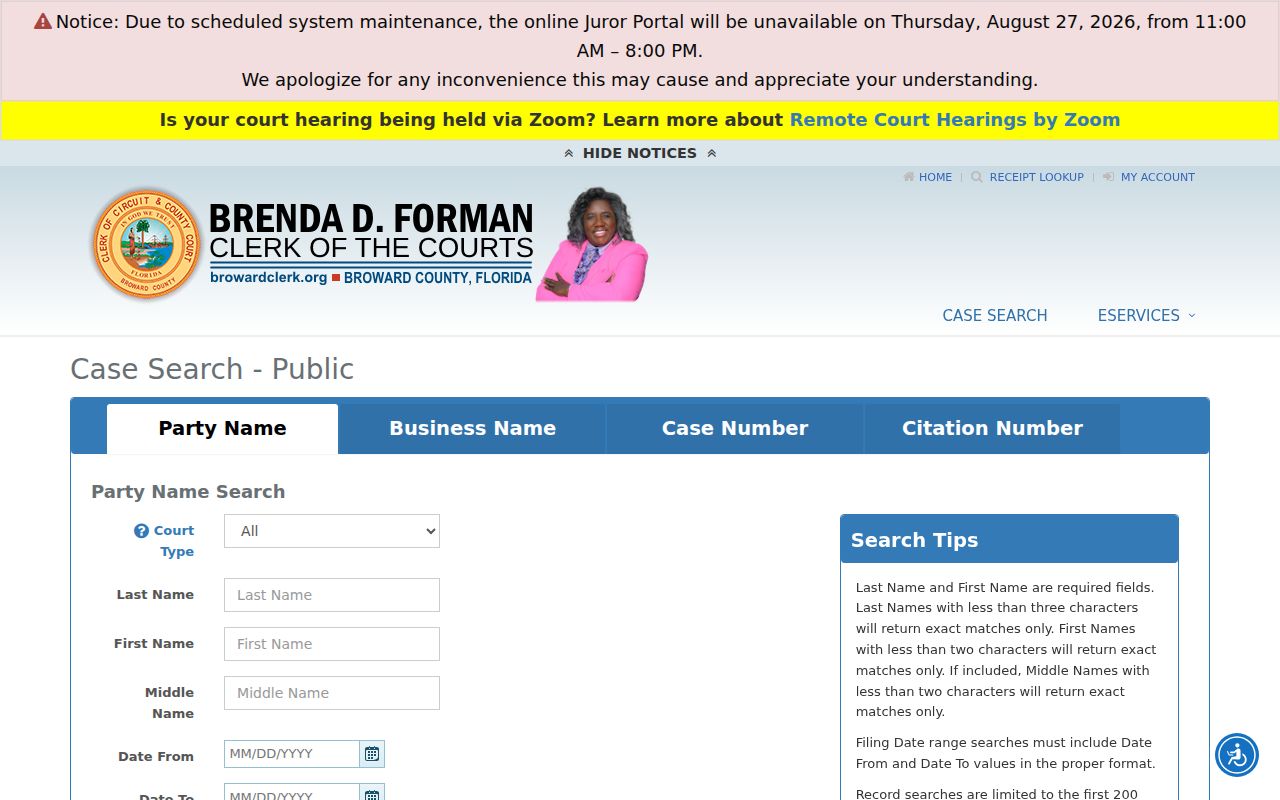
A case detail may add parties and roles, counsel, judge, events, hearings, charges or dispositions, and viewable documents. Presence in a docket does not establish current residence, fault, or wrongdoing. Sealed, expunged, juvenile, adoption, and protected details remain unavailable. Older civil records before April 1, 2023 and criminal records before January 6, 2014 may be requested from Archives when the online document is unavailable; processing may take up to two weeks.
Fort Lauderdale Voter Record Limits
Florida treats voter registration and voting history as public records under sections 97.0585 and 119.01, but the public file is not unrestricted. Social Security numbers, driver-license or state-ID numbers, and the place where a person registered are confidential. Signatures may be viewed but not copied. Address Confidentiality Program participants and other protected voters have additional safeguards. The public records can support a registration link to Broward County, not prove present occupancy.
The Broward voter information service supplies an individual lookup, while the office and Florida Division of Elections provide request channels for larger public extracts.
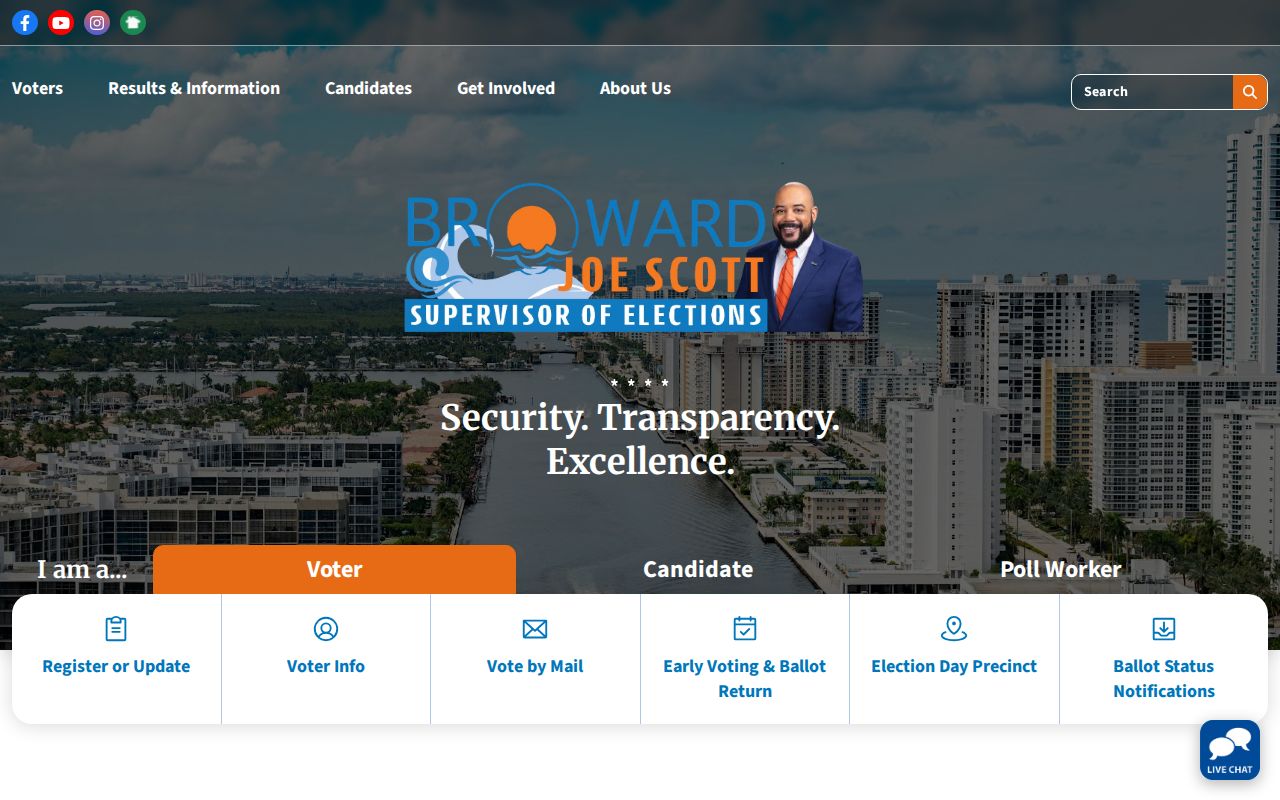
The image marks the official county entry point. A full voter-file request should specify the geographic slice and fields needed. Protected values are excluded, and vote-by-mail information has its own statutory access limits. Always keep the record date because registration data changes.
City GIS Connects Fort Lauderdale Addresses
Fort Lauderdale’s Property Information Reporter adds context that county rolls do not. Enter a standardized address or click a parcel, then inspect tax parcels, zoning, future land use, historic properties, commission and county districts, school and police districts, neighborhood associations, permits, and code cases. Permit data may name an owner, applicant, or contractor and show work, inspections, status, and dates. A code file can name a responsible party. Neither is a list of all residents.
The map also catches a local trap. A postal address using “Fort Lauderdale” can fall outside city limits. When the reporter says details are available only for city properties, verify the municipal boundary before choosing the permit or code custodian. City GIS data updates on different cycles, from daily for some operational layers to annual for others. Unposted maps or datasets can be requested through the city clerk under Florida Public Records Law.
Florida Names Beyond Broward Rolls
State systems provide useful identity anchors after the local search. Sunbiz filings can show an entity status, filing date, principal and mailing addresses, registered agent, officer or manager titles, annual reports, and scanned documents. DBPR results can show a licensee or business, license number and type, rank, status, expiration, main address, and public discipline links. Florida Treasure Hunt searches unclaimed property by owner name and reported locality. Each record proves a dated filing or account link, not continuous residence.
Corrections and law-enforcement records require still more care. Broward Sheriff Arrest Search covers local arrest data, while Florida Corrections covers prison and probation identifiers and status. An arrest is not a conviction. Name-based criminal-history results require identity matching, and sealed or expunged records may not appear. These sources should be used only for lawful personal research and never to harass, track, or harm anyone.
Historical Fort Lauderdale Resident Directories
Older Fort Lauderdale residents appear in three strong local collections. Broward Main Library keeps an electronic searchable city-directory database in the fifth-floor Business, Law and Government Section. The State Library of Florida has city directories arranged by city and year, with statewide holdings spanning the early 1900s to the present. The Library of Congress provides 884 digitized images from Fort Lauderdale white and yellow pages covering January 1941 through February 1947. No verified source establishes an unbroken local Polk run, so a year-by-year shelf question should go to the library desk.
A telephone listing may give a surname or organization, initials, street address, and exchange number. A Polk-style directory may add a spouse, job, employer, or residence marker, but the abbreviation key in that exact volume controls. Compare adjacent years and remember that a missing entry can reflect a move, death, nonrenewal, or omission. Pair the 1941 to 1947 run with the 1940 and 1950 censuses, deeds, newspapers, and Broward Digital Archives. The detailed Fort Lauderdale city directory collection guide explains how to read and compare the entries.
Broward Archives Add Local Context
Broward County Library Digital Archives contains 115 local-history collections with photographs, oral histories, family papers, and civic records reaching from the late nineteenth century forward. Its holdings include school and family collections, images of the 1926 hurricane and 1947 flood, and accounts of agricultural and railroad life. The African-American Research Library and Cultural Center preserves community collections from its Sistrunk Boulevard location. History Fort Lauderdale adds a museum and archival route.
These sources explain why a household changed address or why a street, subdivision, or neighborhood looks different across records. Library databases also include Ancestry Library Edition in branches, Fold3, historical newspapers, and Digital Sanborn Maps through eligible library access. Public federal census schedules are available through 1950 in 2026 under the 72-year rule. A directory name gains meaning when a map confirms the old block and a newspaper, deed, or census supplies a date.
Privacy in Fort Lauderdale Searches
Florida’s broad access law does not erase privacy rules. Birth certificates under 125 years old are confidential. Cause of death stays restricted for 50 years, although a death certificate without cause is more broadly available. Driver and motor-vehicle personal data is limited by the federal Driver’s Privacy Protection Act and Florida law. Court sealing, expunction, juvenile rules, adoption confidentiality, victim protections, and occupation-specific exemptions can remove or redact names and addresses.
Use records with care. A missing result may reflect a lawful protection or a narrow index, while a matching name may belong to someone else.
Florida’s Address Confidentiality Program provides a substitute address for victims of domestic violence, stalking, and related threats, with voter information handled confidentially. Never try to defeat that protection. Correct a bad record with the custodian that created it: the Property Appraiser for a parcel roll, the Clerk for a docket, Elections for voter data, or the relevant state agency for its filing. A careful Fort Lauderdale residents directory search respects both access and the limits written into the law.